 English
 Русский
 Latvian

- News
- 11 Nov 2026
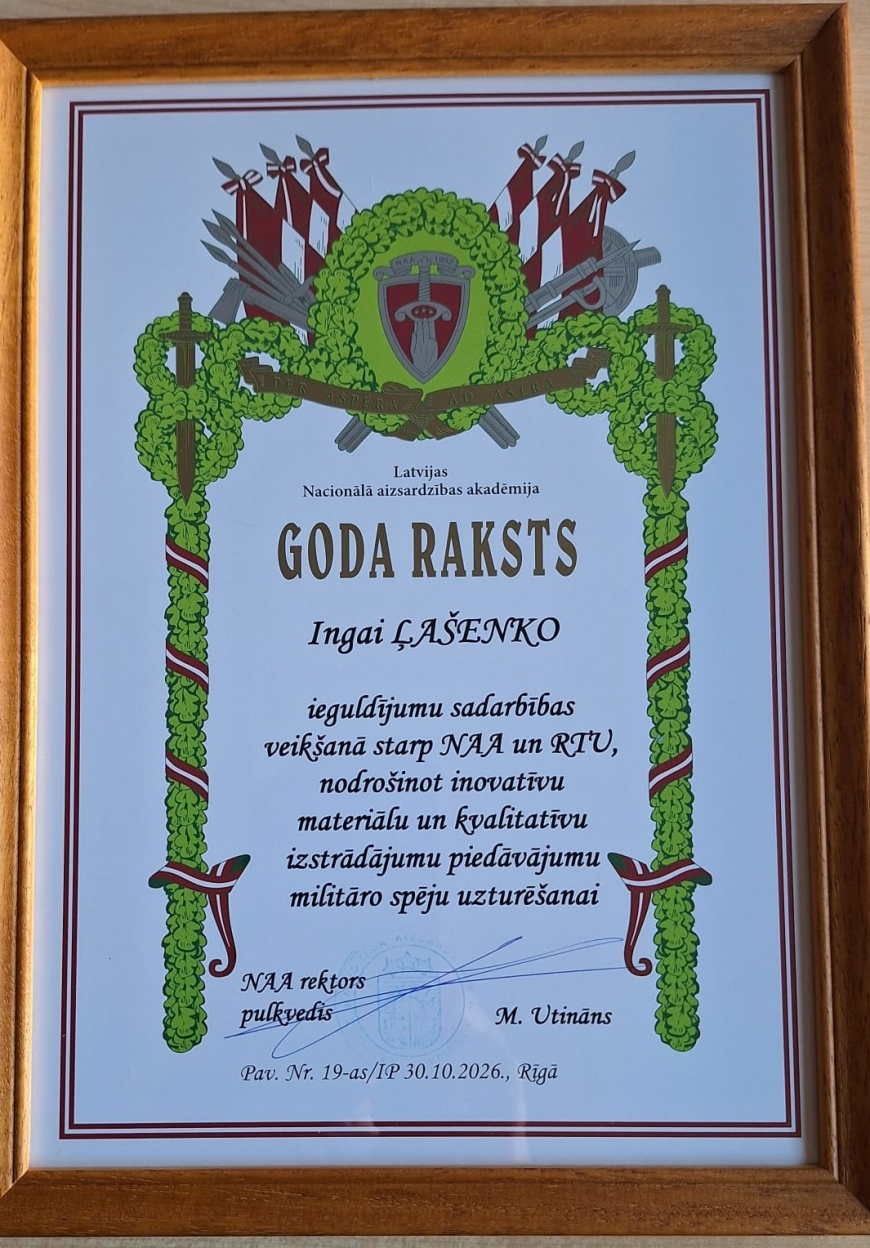
A lightweight and flexible protective material that helps soldiers remain undetected by thermal imaging cameras RTU (Riga Technical University) leading researcher Dr.sc.ing. Inga Ļašenko and her colleagues are working on such solutions. On the eve of Lāčplēsis Day, the researcher received a Certificate of Merit from the National Defense Academy of Latvia (NAA) for special achievements in scientific work and a significant contribution to building strategic cooperation.
The recognition was awarded for strengthening cooperation between the NAA, the National Armed Forces, and the scientific team of the Institute of Mechanical Engineering, Aerospace Technologies and Transport of RTU (Mechanics of Biotextile Materials), also involving partners from the Rēzekne Academy of Technologies.
“Receiving such recognition on the day we honor Latvia's defenders is especially symbolic,” says I. Ļašenko. She emphasizes that the award is an appreciation of the entire team's work and jointly achieved results.
The researchers are developing protective textiles and camouflage ponchos based on ultra-fine fiber or nanofiber materials. They are designed to combine several key qualities essential for a soldier: light weight, flexibility, freedom of movement, and reduced visibility in the infrared spectrum.
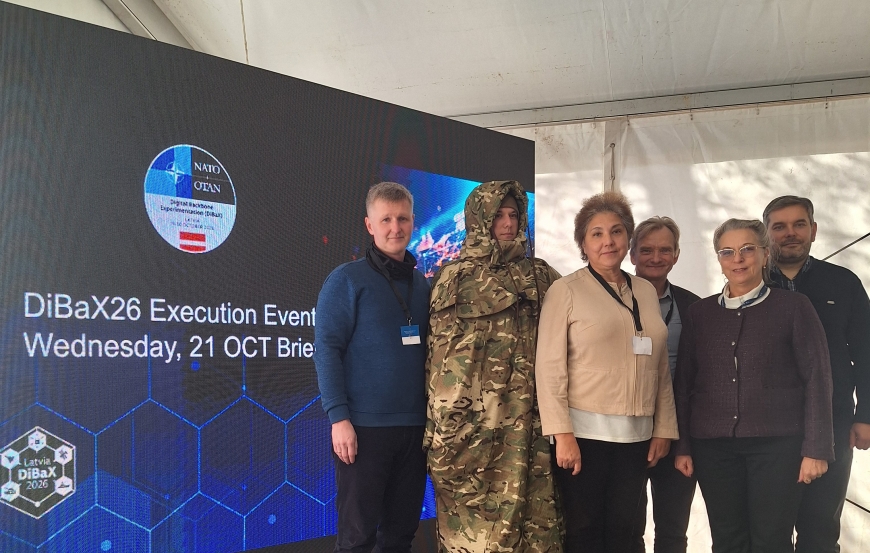
In practice, this means reducing a soldier's visibility to thermal cameras, including those mounted on drones. Such solutions can help improve soldiers' safety and their ability to carry out tasks in challenging conditions. The protective textile and camouflage solutions developed by the team were demonstrated on October 21, 2026, during the NATO military exercise “DiBaX2026.”
The received recognition inspires the team to continue their research from the development of new fibers and materials to practical protective equipment. The goal of the work is to turn scientific achievements into solutions that help protect Latvian soldiers and strengthen national security.
- News
- 11 Nov 2026
Military Ponchos: Protection, Multifunctionality, and Combat Readiness in All Conditions
Military ponchos are one of the most practical elements of any soldier's equipment. Designed to provide maximum protection against infrared radiation, rain, wind, and cold, they are suitable for military operations, for casualty protection and hypothermia prevention, hunting, hiking, or survival training. Modern military ponchos combine tactical design with technologically advanced materials that ensure durability, breathability, and versatile application.
The scientific team participated in the NATO DiBaX2026 (Digital Backbone Experimentation) military exercise to demonstrate the protective capabilities of the developed camouflage suit.
A patent application, LVP2026000069, was submitted for the developed camouflage suit on August 28, 2026. The invention can be used to enhance the quality of camouflage suits, significantly reducing the visibility of the concealed object in the infrared (IR) radiation spectrum through dynamic surface temperature management and effective heat dissipation.
Scientific Rationale of the Project: DronDeflect
The camouflage suit was developed based on the DronDeflect scientific project, funded by the Ministry of Defence of the Republic of Latvia with co-financing from a private enterprise (MoD Contract No. 217/AM/2024).
The objective of the project is to enhance the competitiveness, export potential, and innovation capacity of a Latvian defence and security enterprise in the EU market, as well as to foster cooperation between research institutions and the National Armed Forces (NAF, LV), the National Defence Academy of Latvia (Security Research and Innovation Centre), Riga Technical University (RTU), and RTU Rezekne Academy.
A dual-use product is being developed: DronDeflect (Electromagnetic and Infrared Radiation Shielding Material across the Spectrum – a multifunctional solution: poncho, tent wall, sleeping bag). It can be utilized for both civilian and military purposes (e.g., NAF). The applicability of the developed product in the defence and security sector serves as a counter-drone solution and a passive protective material.
The aim of the scientific project is to engineer an innovative three-layer textile material that serves as an effective concealment element for military or dual-use products. This material will neutralize objects against state-of-the-art automated surveillance assets, including thermal imaging drones, particularly during nighttime (). The project outcomes will fully solve the challenge associated with neutralising surface thermal signatures of concealed objects.
Tactical Design and Military Standards
The military poncho is engineered in accordance with military specification standards, prioritizing protection and durability.
- Materials: Ripstop nylon, polyester fibers, or a waterproof PVC coating that shields against heavy rain and wind while remaining breathable.
- The connecting seams are heat-sealed to prevent moisture ingress, and the adjustable hood design allows adaptability to both forest and urban environments.
- The poncho is designed for long-term field use: it does not tear, does not absorb moisture, and retains its shape even after years of intensive operation.
- Waterproof and Windproof Fabric: Suitable for extreme weather conditions.
- Compact Folding: Easy transport in a backpack or tactical vest.
- Multifunctional Use: Functions as a blanket, tent wall section, or camouflage tarp.
Versatile Application in Combat and Survival Conditions
Modern military ponchos are much more than mere rain protection. They serve as multifunctional equipment usable in various scenarios: as temporary shelter, a hideout, a stretcher, or even a sleeping bag cover.
This model features a snap-button system (integrated eyelet studs) that allows multiple ponchos to be connected together, forming a larger protective area. The poncho is available in specialized camouflage patterns (Woodland, Multicam, Flecktarn), providing optimal concealment in woodland or mountainous terrain. Such versatility renders the poncho an essential element of military gear.
Comfort, Ventilation, and Energy Harvesting
Unlike conventional raincoats, the military poncho provides a superior level of comfort. Its loose fit ensures freedom of movement and adequate ventilation, preventing excessive perspiration even during intense physical activity.
The poncho features a controlled thermal distribution system. It is also equipped with a dedicated device that converts body heat into electricity. The integrated USB converter allows users to charge a mobile phone or tablet, or power a flashlight. Furthermore, its lightweight design and packability allow it to be stored easily in any kit bag without taking up space intended for other tactical gear.
Military Design with Practical Aesthetics
The military poncho is characterized by a minimalist yet functional design: it is available in classic military shades—khaki, olive green, black, grey—or various camouflage patterns. These tones maintain discretion and blend naturally into the surrounding environment. Consequently, the military poncho is also favored by civilian users, such as hunters, mountaineers, and survival course participants, who value its reliability and simplicity.
Conclusions and Industry Impact
Choosing this military poncho delivers dependable protection and top-tier practicality. It is an item of equipment capable of replacing multiple pieces of gear simultaneously: a blanket, raincoat, tent wall, or tarp cover. Durable, lightweight, and versatile—this poncho has proven its value in both active military service and expeditions or hikes.
The outcomes of the DronDeflect project will strengthen European industrial innovation capability and market standing while serving as a reference point for the EU camouflage technology roadmap. These results will foster close collaboration between leading European R&D centers and industry to deliver higher-performance, lighter, greener, EU-manufactured, and more cost-effective concealment solutions for all deployed military personnel in the near future.
This will grant DronDeflect partners a strong competitive edge by focusing on full life-cycle costs (optimizing performance requirements and costs) and environmental standards to reduce dependency on raw materials and systems subject to non-EU restrictions.

- News
- 29 Sep 2026
JLU Technologies SIA is a leading R&D-intensive SME specializing in nano technology to manufacture nano materials and membranes (including mechanochemical activation, nanostructured materials, and sustainable composite engineering). Building on strong scientific cooperation with international academic powerhouses - including Tallinn University of Technology (TalTech, LT) and the University of Nebraska Omaha (USA) - JLU Technologies SIA has developed deep expertise in transforming post-consumer cotton textile waste into high-value functionalized cellulose-based nano level membranes.
By applying proprietary High-Intensity Impact Milling and extreme shear deformation, we upcycle cotton waste into specialized cellulose architectures (CNCs/CNFs) integrated with active nanostructures. These bio-based composite membranes achieve ultra-precise sub-micron filtration (capturing particles and micro-pollutants down to 0.001–0.01 µm), far exceeding standard mechanical pre-filtration.
Next Step: Industrial Approbation with Filter SIA
To transition our laboratory breakthroughs into real-world applications, JLU Technologies is launching the approbation phase for fine water purification membranes in direct collaboration with Filter SIA (Latvia) is a key regional leader in industrial water treatment solutions.
- High Efficiency & Bio-Safety: Proven capability in targeted microplastic retention and pathogen/biofilm inactivation.
- Circular & Eco-Friendly: 100% bio-based membrane cores derived from recycled cotton fibers.
- Plug-and-Play Integration: Designed for seamless integration into industrial and mobile water filtration stations.

Program: M-ERA.NET Call 2021
Project Acronym: 3DNano-HPC
Project Coordinator: JLU Technologies Ltd, Latvia
The objective of the project is the development of innovative 3D biotextile materials based on the establishment of a technological platform, to produce innovative high-performance composite. It represents the complete chain of production, from technological development of new textile to bio-testing applications, and, therefore, provides feedback within the system for optimization of processing requirements, an approach that has not been applied to the previous generation of biotextile materials.
Potential benefits: extension of boundaries to the protective properties of the 3D biotextiles, provide enhanced protection against different frequency & density electromagnetic fields 50 Hz low frequencies, Radiofrequency range, as well protection from ultraviolet radiation and will create of the mechanical barrier from the negatively charged micro pollutant particles.
A new material is very important under contemporary conditions when the majority of population lives in urbanized areas steadily affected with electromagnetic fields, ultraviolet radiation of high intensity and pollutant particles.

- News
- 23 Dec 2021
Dr.sc.ing. Inga Lasenko & team (Head of Mechanics and Biotextile Research Laboratory, Riga Technical University) offers the ECO-SMART-Textile to protect the car cabin in the event of fire inside.
The facing of car interior consists of natural (e. g., leather furnish) or artificial textile materials, which, even with a special fire-resistant treatment, lights up within a few seconds (in the case of fire source in the cabin).
In the case of such fire, every second can be decisive in order to ensure that passengers can get out from the burning vehicle.
ECO-SMART-Textile can be the best decision to protect a car cabin from fire. ECO-SMART-Textile reinforced with an innovative substance (gel and capsules) capable of extinguishing arising flames just in a few seconds.
ECO-SMART-Textile is flexible, mechanically resistant, multibendable, light and thin.
Using of the textile is a classic technique, as textiles are used in one way or another in all areas of the industry.
A number advantages of this upholstery choice can be shown: the textile base is able to take the 3D shape of the interior surface of the cabin; the interlacing of the fibers gives additional strength to the entire applique; the fibers used are natural, renewable raw materials. The composition of the textile base includes: linen, cotton and amber fibers. The raw material combination of the fibers and weaves is carefully thought out. The basis of the fabric includes: linen yarns (strength, low flammability), cotton yarns (softness, flexibility, elasticity) and composite amber fibers (patented the invention, has a brand AMBELIKA®) - unique versatile properties, the main thing is anti-fungal effect.
Condensation water (even in small quantities) can form in the cabin for various reasons, provoking the development of fungi, the spores which seriously harm human health, as well could damage the cabin interior trim. Hereby, it is very important to create a natural (non-chemical) barrier. The solution may be composite amber fibers with their unique anti-fungal properties.
The application ECO-SMART-Textile is capable to create a reliable protective barrier (test results, proposed Know-How) and is necessary for the interior of a modern, highly competitive car. The buyer will not hesitate to choose this product in the car market.
The application ECO-SMART-Textile combines perfect quality, reliability, safety, environmental friendliness, local raw materials, it is an unrivaled success and you need it for perfect car!


- News
- 07 Jun 2021
RTU Leading Researcher Dr.sc.ing. Inga Ļašenko received Award of 2021 Year in Education and Research from Latvian Federation of Security and Defense Industries
The Leading Researcher at Riga Technical University’s, Faculty of Mechanical Engineering, Transport and Aeronautics; Institute of Mechanics and Mechanical Engineering, Department of Theoretical mechanics and material resistances, Leader of the Mechanics and Biotextile Research Laboratory, Dr.sc.ing. Inga Ļašenko received Award of 2021 Year in Education and Research upon the theme “Textile material that reduces infrared and ultraviolet radiation in the thermal spectrum”.
As a result of interdisciplinary international cooperation between RTU, Mechanics and Biotextile Research Laboratory (accredited laboratory), Institute of Biology the University of Latvia (Laboratory of Environmental Genetics) and Nature Research Center, Lithuania (Laboratory of Molecular Ecology), working together in several international projects have been developed and tested effective, relatively cheap and rapid biotesting methods for determining the effects of biotextiles and their components, including nanoparticles, on cells and organisms.
A group of methods for determining the protective properties of textiles against the effects of electromagnetic fields of various wavelengths also has been developed.
“In modern combat using unmanned aerial vehicles, infrared radiation makes it very easy to detect living objects in the forest. We have managed to create a high quality fabric that is invisible under infrared and heat absorbing video surveillance equipment.
A creative and scientific approach to the study of the problem is based on knowledge of textile technology, physics (optical properties of materials), chemistry of textile fibers. This material effectively hides living objects from the thermal cameras. In our sample, we made an universal product - a sleeping bag, poncho, camouflage suit and stretcher. But most importantly, it effectively hides from surveillance of the unmanned aerial vehicles, equipped with infrared video surveillance devices.
The product fully meets the requirements for the development of certain protective properties, i.e. an improvement has been achieved: the temperature difference between the environment (objects) and the masked object not exceed 2oC”, - says Inga Ļašenko.
Currently, Mechanics and Biotextile Research Laboratory (RTU) has the potential to develop the biotextiles almost any degree of complexity, including nanocomposite biotextiles, as well as to prepare a scientifically based expert opinion about the quality of biotextiles based on European Standards.
Cooperation with leading European institutes for the biotextiles development (Schulung Grundlagen der Textiltechnik am Institut für Textiltechnik (RWTH) Aachen, Germany; Centexbel, the scientific and technical centre of the Belgian Textile industry; University of Rouen Normandy - UFR Science and Technology, France; University of Rome «La Sapienza», Faculty of Engineering, Rome, Italy; AITEX, Instituto Tecnológico Textil / Textile Research Institute, Spain, and others) provides an opportunity to develop innovative technologies and promote Latvian developments in the field of biotextiles in Europe and the World.
The Award of 2021 Year in Education and Research area from the Latvian Federation of Security and Defense Industries is awarded by an interdisciplinary jury, composed of representatives of the Latvian Federation of Security and Defense Industries, Latvian Academy of Sciences, Ministry of Defense, Ministry of Internal Affairs, Ministry of Foreign Affairs, Ministry of Economy and Ministry of Education and Science.


